
Key Takeaways:
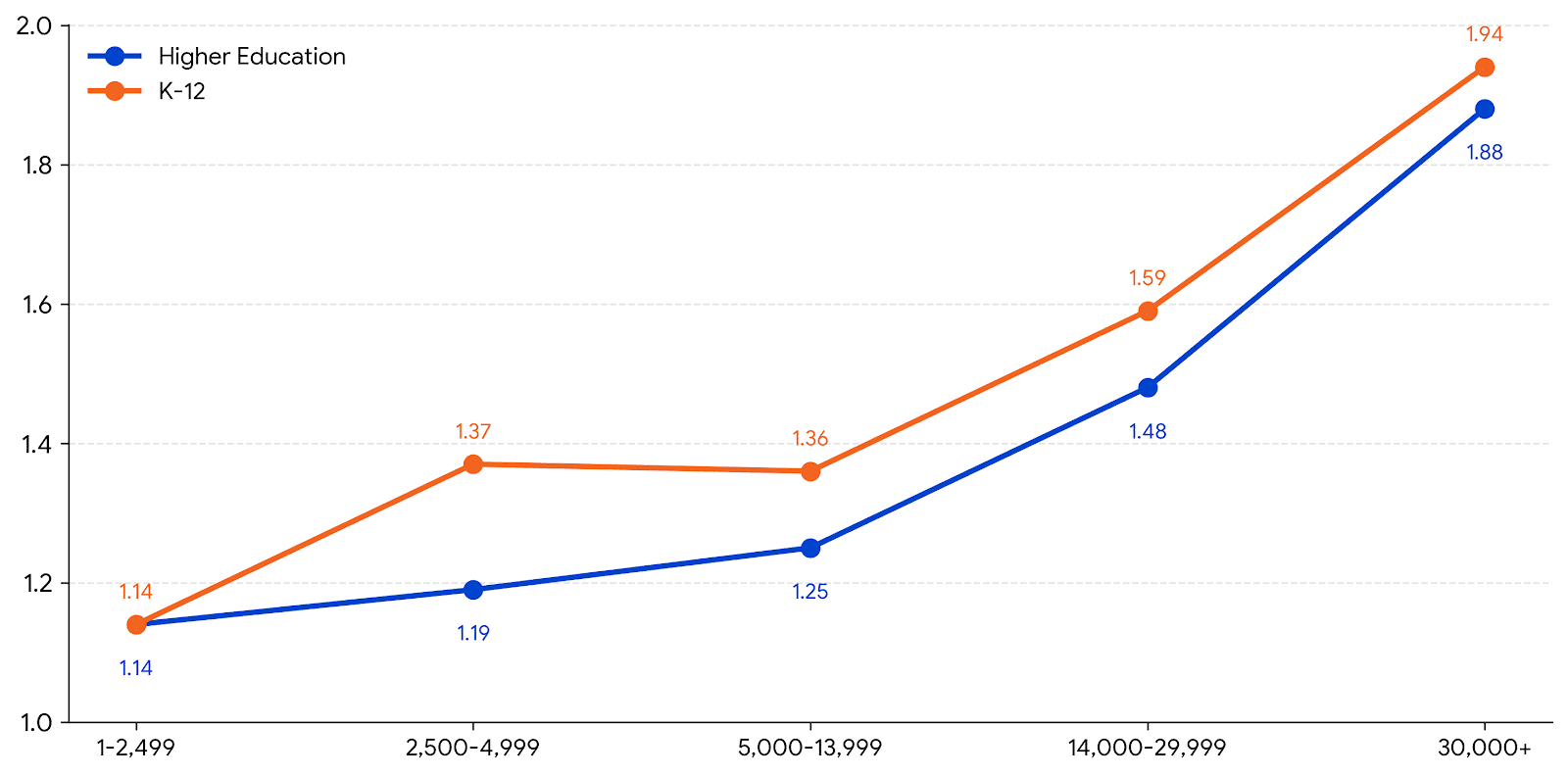
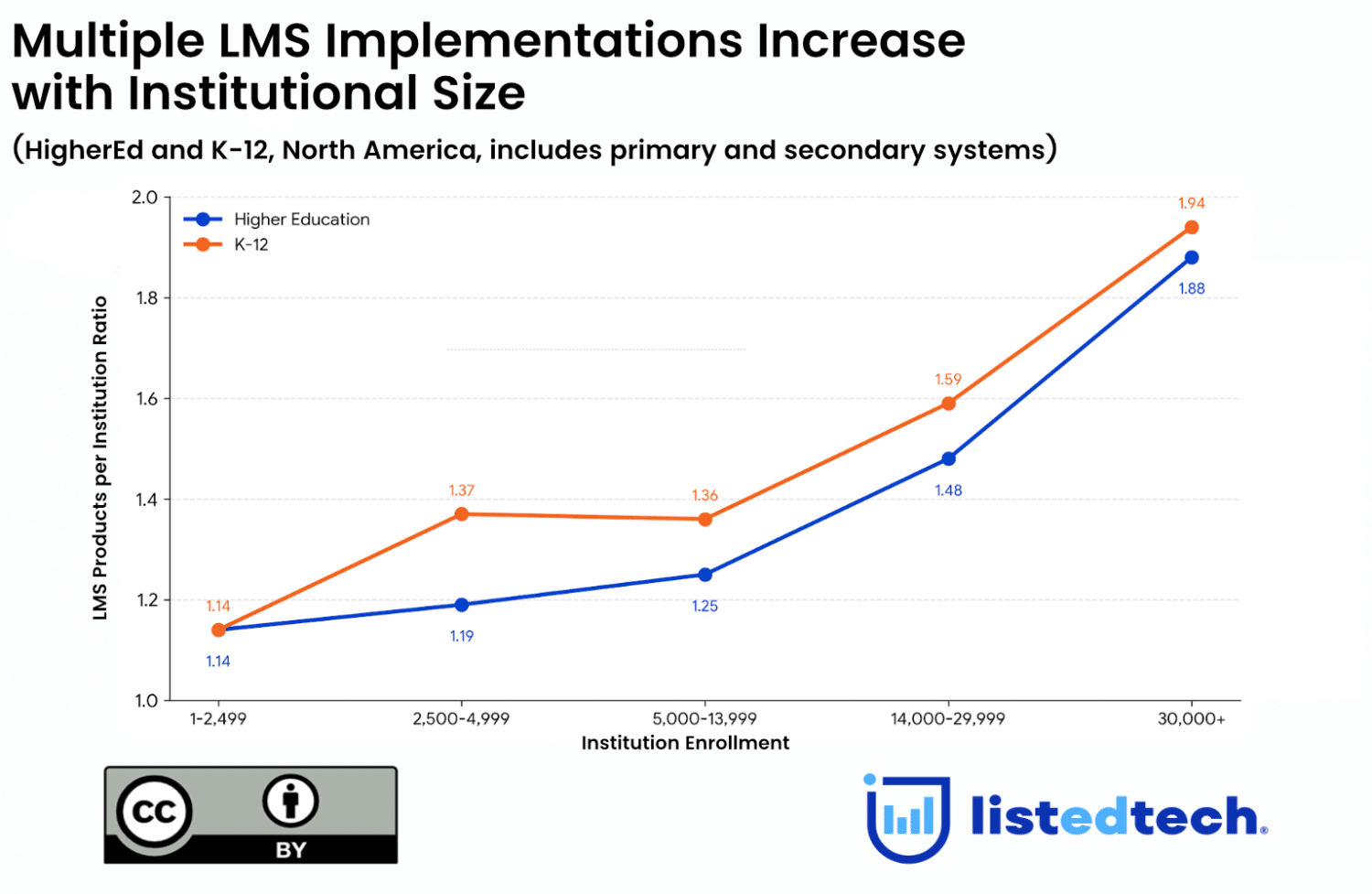
- Complexity Escalates with Scale: Rather than fully standardizing on a single system, larger educational organizations naturally diversify; institutions with massive student enrollments show the highest rate of secondary LMS implementations.
- Decentralized Institutional Needs: Multi-LMS environments are rarely accidental; they are deliberate portfolios where distinct platforms are paired to support specialized audiences, such as continuing education hubs, professional medical schools, or primary K-12 classrooms.
- Ecosystems Over Market Share: Traditional market-share metrics that count institutions as single-platform adopters miss a massive secondary footprint, overlooking the reality that modern education relies on a portfolio of agile, coexisting learning platforms.
Last year, we uncovered an interesting shift in the K-12 landscape: the myth of the “one-district, one-LMS” model was cracking. Instead of rallying behind a single learning management system, many school districts were quietly operating multiple platforms simultaneously, often pairing the nimble simplicity of Google Classroom with a traditional heavyweight like Canvas, Schoology, or Moodle.
That discovery left us with a lingering question: Is this dual-adoption phenomenon unique to K-12, or are we witnessing a fundamental shift across all of education?
To find out, we dove back into the ListEdTech data. The verdict is in, and it’s definitive. This isn’t just a K-12 quirk. In fact, when you look at Higher Education, the multi-LMS reality is even more pronounced.
Moving Beyond the “Winner-Takes-All” Market Share
For years, industry analysis has treated LMS adoption like a winner-takes-all board game. The standard industry assumption was simple: an institution evaluates the market, selects a platform, and standardizes it across the board.
But our data, which tracks both primary and secondary LMS implementations, reveals a far more nuanced story.
When you peer beneath the surface, especially at larger institutions, the concept of a single, monolithic learning environment begins to fade. In its place, we are seeing the rise of diverse learning ecosystems: portfolios of distinct platforms intentionally curated to serve different audiences, programs, and instructional demands.
The Scale of Complexity: Where Enrollment Meets Ecosystems
Why is this happening? The answer lies in a striking correlation within our database: as institutional size grows, the likelihood of multiple LMS implementations skyrockets.
At first glance, this might seem counterintuitive. Wouldn’t a massive institution want to standardize to keep IT support costs down? In theory, yes. But in practice, organizational reality trumps theoretical simplicity.
A tight-knit college serving 2,000 students can easily rally around a single LMS. A mega-university serving 40,000 students is a completely different beast.
Large universities operate less like single businesses and more like complex conglomerates. They are vast networks of faculties, professional schools, continuing education divisions, and online learning units, each with its own governance, distinct budgets, and unique instructional needs.
Our data shows that secondary systems are rarely accidental leftovers or temporary oversights; they are deliberate, permanent fixtures designed for specialized use cases.
Mapping the Multi-LMS Higher Ed Reality
The larger the enrollment, the steadier the climb in secondary LMS implementations. Instead of representing a failure to standardize, this trend reflects the sophisticated organizational architecture of modern higher education.
Walk onto a major campus today, and you are highly likely to find a patchwork of platforms tailored to specific missions:
- The Flagship: A campus-wide LMS dedicated to core undergraduate and graduate instruction.
- The Agility Hub: A separate, flexible platform driving non-credit continuing education and workforce development.
- The Specialist: A standalone, highly specialized LMS configured for the unique clinical requirements of medical or law schools.
- The Legacy & The Future: Coexisting platforms managing a multi-year, phased migration, or systems inherited through recent institutional mergers.
Viewed through this lens, the multi-LMS campus isn’t an operational anomaly: it is the natural byproduct of growth.
A Shared Pattern in K-12
We see this same tension between scale and standardization playing out in K-12. Large school districts consistently mirror the Higher Ed pattern, frequently blending Google Classroom’s intuitive, day-to-day workflow with the robust assessment tracking of a traditional LMS.
While the individual use cases differ, the underlying driver is identical: as an educational organization scales, the urgent need for pedagogical flexibility routinely outweighs the administrative desire for total standardization.
Rethinking LMS Market Analysis
For institutions, vendors, and consultants alike, these findings challenge the traditional boundaries of market-share discussions.
If we only count institutions as single-platform adopters, we blind ourselves to the massive footprint of secondary systems. Modern educational institutions aren’t just buying an LMS; they are managing an ecosystem. They are choosing agility over uniformity to better serve diverse learner demographics.
Final Thoughts: The Reality of Modern Education
What started as an intriguing pattern in K-12 last year has evolved into a clear, sector-wide reality. As educational organizations become larger and more complex, multi-LMS environments become increasingly common. What may appear as dual adoption from the outside often reflects the reality of serving different learners, departments, and instructional models within the same organization.
The rise of the multi-LMS campus isn’t a sign of system failure. It is simply the shape of modern education at scale.