
Key Takeaways:
- Complexity Scales with Size: Campus software portfolios expand exponentially with school size.
- High Market Consolidation: Core infrastructure categories like the LMS, SIS, and email are heavily concentrated around just two to five vendors, creating dangerous single points of failure.
- Resilience Demands Visibility: True digital resilience goes beyond basic cybersecurity; it requires full transparency into system integrations and vendor dependencies to prevent cascading failures.
Every day, college and university IT departments face a balancing act. On one hand, campus leaders are eager to deploy new artificial intelligence tools, migrate legacy data to the cloud, and roll out specialized software to improve everything from admissions to alumni relations. On the other hand, budgets are shrinking, cyberthreats are growing, and specialized IT talent is harder to find than ever.
In this rush to modernize, a quiet but dangerous vulnerability has taken root across higher education: sheer technological complexity.
A new paper from IDC, the Education Digital Resilience Framework, sheds light on this exact challenge. The guide is designed to help institutions navigate today’s volatile tech landscape. At ListEdTech, we were glad to contribute our market data to this research because the framework’s central message aligns perfectly with what we see every day: institutions cannot manage the risks they cannot see.
True digital resilience isn’t just about building stronger firewalls. It begins with mapping the massive web of software systems your campus relies on, understanding your true vendor dependencies, and identifying hidden vulnerabilities before they turn into operational crises.
The Reality of Campus Software Bloat
It is easy to underestimate how many digital tools it takes to run a modern college or university. Higher education software portfolios don’t appear overnight; they stack up organically over decades. Every time a department needs a specialized tool for grading, facility management, or student support, a new application is added to the pile. Old systems are rarely fully retired because decoupling them from legacy campus infrastructure is incredibly difficult.
The data we shared with IDC highlights just how quickly this complexity scales based on the size of an institution:
- Small Institutions (1,000 to 2,499 students): Manage an average of 16 distinct applications and systems.
- Large Institutions (30,000 or more students): Manage an astonishing average of 141 separate applications and systems.
Think about what those numbers actually mean for a campus IT department. Every single application represents a unique contract to manage, a new vendor relationship to track, a stream of software updates to test, and a potential backdoor for data breaches. When you have 141 different systems trying to talk to one another, a minor update to a single application can trigger a cascading failure across dozens of other departments.
The Domino Effect of Vendor Concentration
While managing over a hundred applications is a massive operational headache, the IDC framework exposes an even deeper systemic vulnerability: vendor concentration.
On the surface, higher education looks like a highly diversified software market. Schools buy applications from hundreds of different providers. However, when you look closely at the core software categories that actually keep a campus running, a tiny handful of companies hold nearly all the power. If one of these major vendors suffers an outage or a cybersecurity incident, it doesn’t just impact one school; it can paralyze a huge portion of the entire higher education sector all at once.
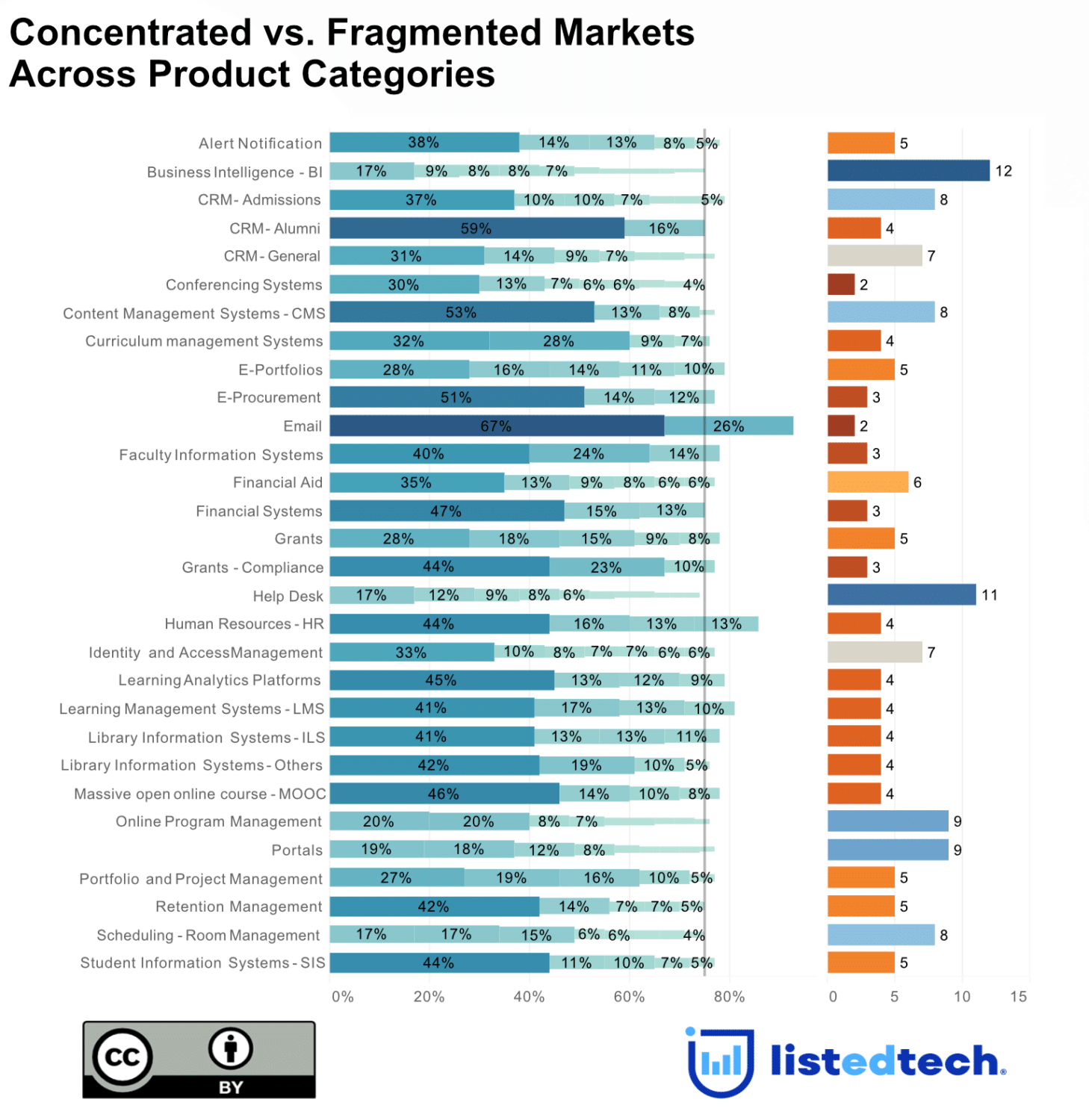
Our market data reveals just how consolidated these critical software categories have become. Here is a look at how few vendors account for roughly 75% of all implementations across the market:
Some notable examples include:
- Email: Just two vendors control three-quarters of the market.
- Alumni CRM: Two vendors dominate.
- E-Procurement: Three vendors handle the vast majority of digital purchasing.
- Learning Management Systems (LMS): Just four vendors host the digital classrooms for most students.
- Student Information Systems (SIS): Five vendors hold the keys to core student data and enrollment.
- Admissions CRM: Seven vendors manage the prospective student pipeline.
Compare that to fields like Business Intelligence or Help Desk platforms, which remain highly fragmented with dozens of competing providers.
This extreme concentration gives schools excellent standardization and efficiency. Everyone is using the same trusted tools. But it also creates a massive structural risk. When a single provider dominates an essential service like email or student records, they become a single point of failure for the entire academic community.
Redefining What it Means to Be Resilient
Historically, higher education has treated digital resilience as a synonym for cybersecurity. If the IT team could prevent a data breach, the institution was considered resilient. The IDC framework pushes past this narrow view, arguing that true resilience is about operational continuity. It is about how quickly a university can adapt when a critical vendor goes offline, changes its pricing structure, or suddenly changes its product roadmap.
To help institutions evaluate their readiness, the IDC framework breaks resilience down into five distinct dimensions:
- Organization: the ability to act as one and adapt as conditions change. It rests on three things: the people who run the institution, the knowledge they carry, and how decisions get made and acted on;
- Finance: the ability to make deliberate resource decisions under constraint;
- Operations: the ability to keep the institution’s core work running through disruption and to adapt processes as conditions change;
- Technology: the reliability and adaptability of the systems, data, and infrastructure the institution runs on, and its ability to withstand both attack and disruption;
- Ecosystems: the ability to manage what it depends on beyond its own walls.
Every single one of these dimensions requires total transparency. You cannot prepare for a disruption if you don’t know your baseline.
Conclusion: Visibility as a Strategic Priority
As universities rush to integrate new AI tools and shift more infrastructure to the cloud, the complexity of campus technology is only going to accelerate. Digital resilience isn’t a project with a clear end date; it is an ongoing strategy. Before navigating the next major tech shift, institutional leaders must be able to answer four fundamental questions: Which software applications are absolutely vital to our daily operations? Which of our vendors represent the highest concentration risk if they experience an outage? Where do our most critical data integrations live? And if a primary system goes down, how will that disruption ripple across other departments?
For over a decade, our mission at ListEdTech has been to help the education community map and understand these exact technology landscapes. Seeing IDC highlight ecosystem visibility as a cornerstone of modern digital resilience validates everything we work toward. As technology becomes inseparable from the student experience, keeping a clear, updated map of your software ecosystem is no longer just a best practice for the IT department. It is a strategic requirement for the entire institution.