Key Takaways:
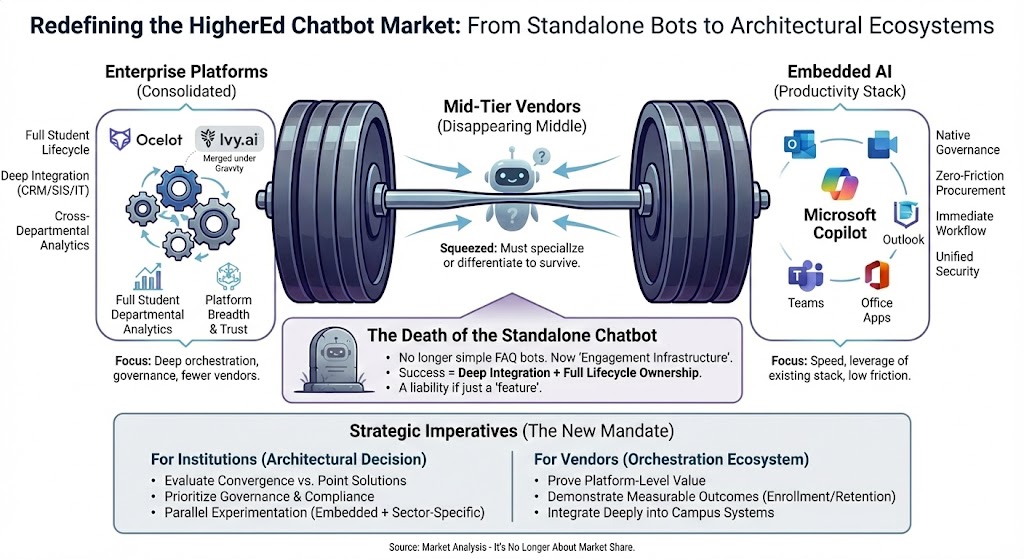
- Market Polarization: The category has shifted into a “barbell” structure, dominated by massive consolidated platforms at one end and embedded AI (like Microsoft Copilot) at the other, leaving little room for mid-tier vendors.
- Architectural Infrastructure: The standalone chatbot is dead; AI is now an architectural decision. Success depends on deep integration across the student lifecycle rather than simple conversational capability.
- The Ecosystem Battle: Chatbot vendors no longer just compete with each other; they are competing with the entire enterprise productivity stack, which offers superior governance and lower procurement friction.
The higher education chatbot market has moved well beyond its “early adopter” phase. It has now entered a profound structural transition. As a result, we are no longer talking about installation counts or leaderboard rankings. Instead, the focus has shifted toward high-stakes territory. This includes platform control, AI orchestration, governance, and total lifecycle ownership.
The Barbell Effect: Polarization of the Market
This transition has created a classic “barbell” structure in the category. This shape is now driving strategic behavior at both ends of the spectrum. At one end, we see scaled, enterprise-grade engagement platforms. A key example is the consolidation of Ocelot and Ivy.ai under the Gravyty umbrella. These platforms compete by providing deep, cross-departmental orchestration.
Conversely, fast-moving, AI-native challengers like Microsoft Copilot are at the other end. They leverage institutional productivity ecosystems to move at a higher velocity. These tools compete primarily on speed and governance leverage. This polarization leaves mid-tier vendors in a precarious position. To survive, they must navigate differentiation or narrow specialization. Otherwise, they risk being squeezed by the giants on either side. Ultimately, the middle ground is rapidly disappearing.
The Death of the Standalone Chatbot
As the market polarizes, the very definition of a “standalone chatbot” is dying. Consequently, institutions are moving past simple FAQ bots. They now prefer tools that act as essential engagement infrastructure. The current expectation is deep integration across the entire technical stack. This includes CRM systems, Student Information Systems (SIS), and IT service layers.
We see this evolution clearly in how Microsoft extends Copilot across Outlook and Teams. Similarly, Ocelot’s integration with Ivy signals a move toward managing the entire student lifecycle. Because of this, the strategic question for an institution has changed. It is no longer “Does this answer questions well?” Instead, leaders ask, “How does this orchestrate engagement across the student journey?”
Consolidation and the Strategic Reset
This move toward orchestration is driving a significant strategic reset across the industry. For instance, the combination of Ocelot and Ivy.ai reflects three core realities of the modern campus. First, institutions want fewer vendors. Second, they prioritize governance over conversational novelty. Third, cross-departmental analytics have become a top priority.
This consolidation signals that competitive advantage is now defined by platform breadth and institutional trust. Therefore, vendors that remain narrowly positioned as “chatbots” will likely fall behind. In this new landscape, being a mere “feature” is a liability. Being a comprehensive “ecosystem” is the new requirement.
Embedded AI Redrawing the Map
The most disruptive force in this category is not necessarily a traditional chatbot vendor. Instead, it is embedded AI. Platforms like Microsoft Copilot are accelerating adoption by layering directly onto the software institutions already pay for. This effectively turns a procurement hurdle into a simple feature activation.
By leveraging the existing productivity stack, embedded AI offers four critical advantages:
- Native Governance: It operates within the institution’s established data boundaries.
- Zero-Friction Procurement: There is no need for new vendor security reviews or contracts.
- Immediate Workflow Automation: AI is already present where the work happens, such as in Outlook and Teams.
- Unified Security: It inherits the identity and access management policies already in place.
This creates a new competitive dynamic. Chatbot vendors are no longer just competing with each other; they are competing with the entire enterprise productivity stack. This shift is forcing a fundamental re-evaluation of every third-party platform.
The Evolution of Messaging and General AI
While enterprise platforms consolidate, specialized channels like SMS face their own evolution. For example, Modern Campus (Signal Vine) remains strategically important for student reach. However, SMS alone is no longer a sufficient value proposition. Future momentum for these players depends on AI-assisted workflows and demonstrated retention outcomes.
This sits alongside the “two-speed” reality of general-purpose AI. While central IT evaluates governed, enterprise-grade deployments, faculty and staff often experiment independently with tools like ChatGPT. Over time, institutions will need to reconcile these decentralized patterns. The goal will be to create a coherent, institutional AI governance strategy.
What This Means for Institutions
Ultimately, the chatbot is no longer a feature purchase. It is an architectural decision. Therefore, institutions should evaluate platform convergence versus point solutions. The focus must remain on governance, compliance, and maintaining exit flexibility. Perhaps the smartest strategy is structured parallel experimentation. By testing embedded AI alongside sector-specific platforms, colleges can see which drives the best outcomes for specific student needs.
What This Means for Vendors
For vendors, the mandate is clear. The battleground has shifted from conversational capability to sophisticated orchestration. Consequently, three strategic imperatives have emerged:
- Prove platform-level value.
- Demonstrate measurable outcomes like enrollment or retention.
- Integrate deeply into the systems that already run the campus.
Vendors that fail to evolve from “chat tools” to “orchestration ecosystems” will soon find themselves sidelined.