

Key Takeaways:
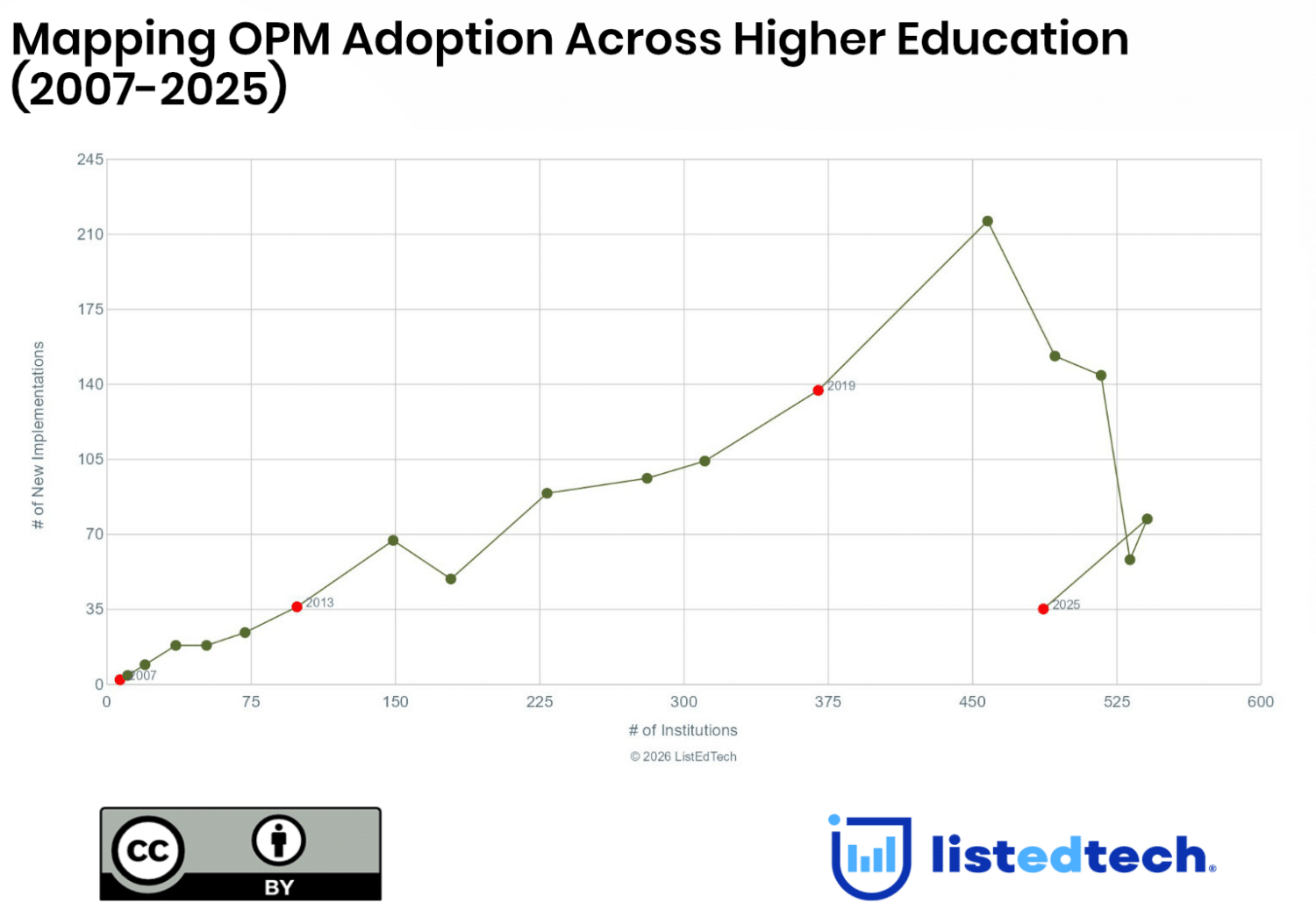
- The OPM Market Has Sharply Contracted: After peaking around 2020–2021, the market has gone into reverse. By 2025, new implementations plummeted to about 35, and active partnerships fell below 490.
- Institutions Aren’t Quitting Online Ed, They’re Insourcing: Driven by matured internal capabilities, roughly 9 out of 10 universities still plan to launch online programs, but they are bypassing traditional vendors and their perpetual fees.
- The Death of the Bundled Contract: Regulatory pressure, legal scrutiny over revenue-sharing, and diminishing returns from aggressive marketing tactics are pushing higher education toward unbundled, fee-for-service models and specialized agency support.
For over a decade, the Online Program Management (OPM) trajectory was a one-way climb: more institutions signing on, more bundled revenue-share agreements, and rapid catalog expansion.
Recent data tells a starkly different story: as shown on ListEdTech’s Adoption Curve graph, the market didn’t just plateau, it looped backwards. After peaking above 540 institutions (remember that we usually capture 80% of the market) and well over 200 annual implementations around 2020–2021, the market has sharply contracted. By 2025, new implementations collapsed down to approximately 35, and the total count of institutions actively partnering with an OPM dropped to under 490.
Why Are Universities Walking Away from Contract Renewals?
Universities aren’t abandoning online education, in fact, roughly 88% still plan to launch new online programs (Chloe 10 Report). Instead, they are rethinking how they deliver and market them:
- The In-House Pivot (DIY): A decade ago, schools needed outside capital and infrastructure to launch at scale. Today, internal capabilities have matured. Institutions are taking back control of their instructional design, academic governance, and student advising rather than handing over 40%–60% of tuition in perpetuity. As Risepoint’s CEO candidly acknowledged in an interview with Phil Hill, an OPM’s primary competitor today isn’t another vendor, it’s the institution’s own internal team.
- Unbundling and Traditional Marketing Agencies: Relying on expensive digital ads and aggressive enrollment call centers, the traditional OPM playbook has run into diminishing returns, skyrocketing costs, and brand fatigue. Rather than locking into inflexible revenue-share contracts, institutions are increasingly shifting to fee-for-service models or hiring specialized agencies for targeted support while keeping core operations in-house.
- Regulatory Pressure & Stigma: Between state-level legislation (like Minnesota banning public university tuition-share agreements) and federal scrutiny around the Third-Party Servicer (TPS) exception, long-term bundled revenue sharing carries legal, financial, and reputational risk.
The Bottom Line: The days of the one-size-fits-all, bundled OPM contracts are fading. Surviving providers are either consolidating around specialized capabilities (such as healthcare clinical placements) or shifting toward unbundled enablement.
For HigherEd leaders, the question is no longer “Should we outsource our online programs?” It is: “Which specific capabilities do we truly need to buy, and which must we own?”