
Key Takeaways
- Prioritizing Foundation Over Fluff: Jenzabar paused new feature development to focus entirely on platform stability, performance, and transparency.
- Practical AI Utility: Instead of marketing hype, their AI strategy focuses on practical tools for faster reporting, automation, and student success.
- Successful Cloud Consolidation: The vast majority of Jenzabar’s customer base has successfully migrated to Jenzabar One and SaaS deployments.
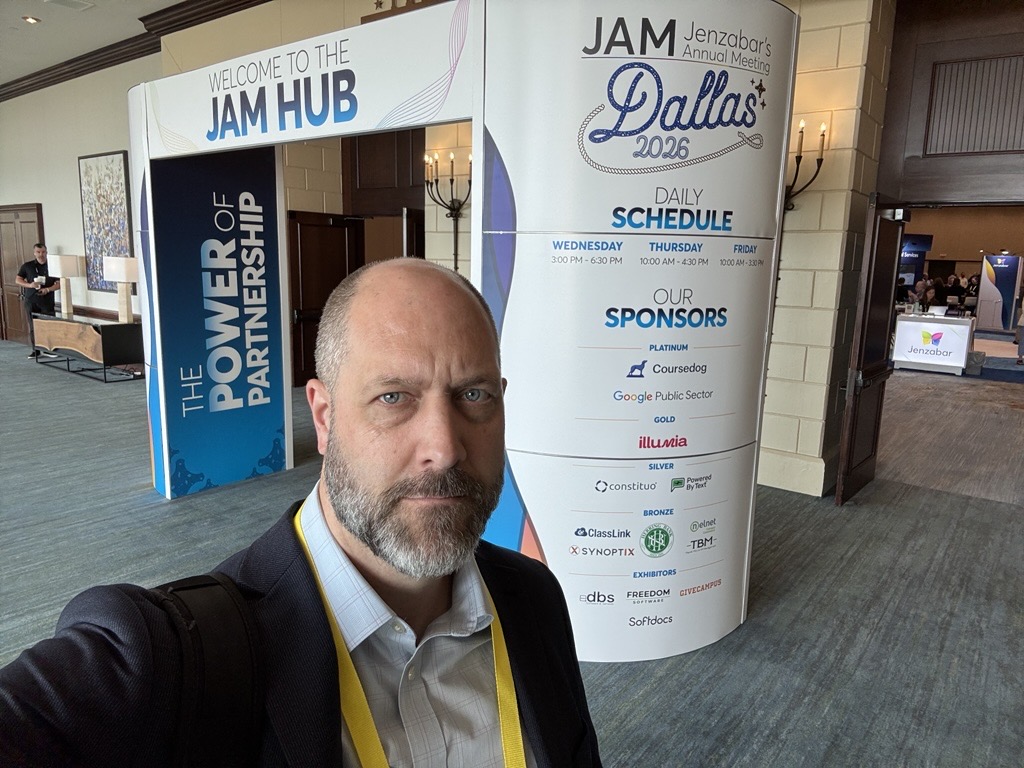
Last week, I attended my first Jenzabar Annual Meeting (JAM) in Dallas, Texas. As a relatively new partner to Jenzabar, we saw this event as a chance to better understand the company, its clients, and the direction of the platform. After all, every conference has its own personality, some feel like sales rallies, while others feel like technology showcases. JAM 2026, however, felt more like a community of institutions working through a shared journey.
Because of that community focus, one thing stood out immediately: it took almost a full day before someone even mentioned AI. In 2026, that is highly unusual. If I had shown up with a standard conference bingo card featuring “AI transformation,” “agentic future,” and “revolutionary disruption,” I would have lost badly. Instead, the conversation in Dallas was focused on something far less glamorous but arguably more important: performance, reliability, security, accessibility, reporting, and customer success.
A Surprisingly Honest Keynote
The most memorable moment of the event came during the product roadmap keynote, when Jenzabar leadership openly acknowledged that much of their 2027 roadmap looked remarkably similar to the one presented in 2026. This kind of admission is rare in enterprise software, but the reasoning behind it was straightforward and customer-centric.
They explained that they had intentionally paused portions of new feature development to focus heavily on the fundamentals: improving platform performance, load balancing, bug reduction, and the overall user experience. The message to the audience was simple: “We heard customers. The platform needed to be faster and more reliable before we added more features.” At a time when most vendors are racing to showcase the next flashy, AI-powered capability, Jenzabar’s decision to spend last year perfecting their foundation was both refreshing and deeply impactful.
What Clients Told Me
When speaking with institutions throughout the conference, a common theme emerged. While nobody typically attends an ERP conference out of excitement for the software itself, many of the customers I encountered seemed genuinely satisfied. This satisfaction wasn’t based on a belief that the platform is perfect, but rather on the fact that they feel well-informed.
Institutions consistently mentioned that they understand what is being worked on, what the priorities are, and where the platform is headed. Jenzabar’s regular open product sessions, where customers can directly engage with product leadership, appear to be a foundational element in building and maintaining that trust.
The Migration Story
One of the most notable takeaways was how far Jenzabar has progressed in consolidating its customer base onto Jenzabar One. Nearly all customers are now operating on the flagship platform, with only a small number remaining on older systems. Furthermore, the majority (about 80%) have successfully transitioned to SaaS deployments, a crucial milestone given that the higher education software market is rapidly becoming an entirely cloud-driven landscape.
Modernizing a Legacy Platform
The roadmap highlighted several major initiatives:
- Continued migration to Google Cloud infrastructure
- Improved SaaS capabilities and scalability
- New web-based admissions functionality
- Expanded reporting and analytics tools
- AI-assisted reporting and workflow generation
- Student Success capabilities built around predictive analytics
- Ongoing investment in accessibility and security
Interestingly, Jenzabar’s AI strategy was far more practical than promotional. Instead of focusing on replacing staff, the emphasis was on empowerment: helping users build reports faster, automate workflows, summarize information, and identify at-risk students more efficiently. In other words, they are positioning AI as an operational utility rather than a marketing slogan.
The Market Reality
Of course, Jenzabar is operating in one of the most competitive periods the higher education ERP market has ever seen, as institutions continue to migrate toward cloud-native alternatives. Vendors such as Workday have been highly successful in capturing new implementations, while many legacy ERP providers are experiencing customer erosion. Jenzabar’s response appears to be a calculated effort to position itself as a stable, lower-risk alternative dedicated to serving small and mid-sized institutions.
The strategy can be summarized as:
- Modernize the platform
- Improve the customer experience
- Reduce migration friction
- Focus on enrollment, retention, and student outcomes
- Build practical AI capabilities into existing workflows
Whether that strategy reverses market share pressure remains to be seen, but it was clear throughout JAM that the company understands the challenge.
Final Thoughts from JAM 2026
The most surprising thing about JAM 2026 wasn’t a specific product announcement; it was the tone. In an industry increasingly obsessed with disruption, Jenzabar’s message focused squarely on execution: faster systems, fewer bugs, better reporting, increased transparency, and more customer engagement. While those goals may not generate the loudest tech headlines, they are exactly what matters most to institutions currently managing enrollment pressures, staffing shortages, and strict budget constraints.
From a ListEdTech perspective, JAM provided a timely reminder that while AI and total cloud transformation dominate industry headlines, many institutions still evaluate vendors on a much simpler metric: can they trust the platform, and the people behind it?
What are you hearing from Jenzabar institutions? Are they prioritizing AI innovation, platform modernization, or simply operational stability? We’d love to hear your perspective.
Note: Jenzabar is a client of ListEdTech. While they sponsored a portion of our travel expenses for this event, all thoughts, observations, and words in this post are entirely our own.