

Key Takeaways
- Strategic IT Investments are Critical: Higher education institutions prioritize IT sustainability to safeguard security, ensure efficient governance, and support academic and administrative processes amid increasing operational demands.
- Key IT Trends Identified: Research across 78 institutions highlights trends such as cybersecurity enhancements, cloud-based system transitions, AI integration, and initiatives supporting inclusivity and mental health.
- Data-Driven Insights: By analyzing centralized IT project data, we gain insights into campus-wide challenges, evolving technological landscapes and community-focused technology planning.
The sustainability of IT systems is central to the security and governance of HigherEd institutions. As campuses face increasingly complex operational demands, investment in strategic IT priorities has become imperative. These projects not only protect institutional data but also ensure the seamless operation of academic and administrative processes, providing the infrastructure necessary for collaboration, innovation, and compliance with evolving regulations.
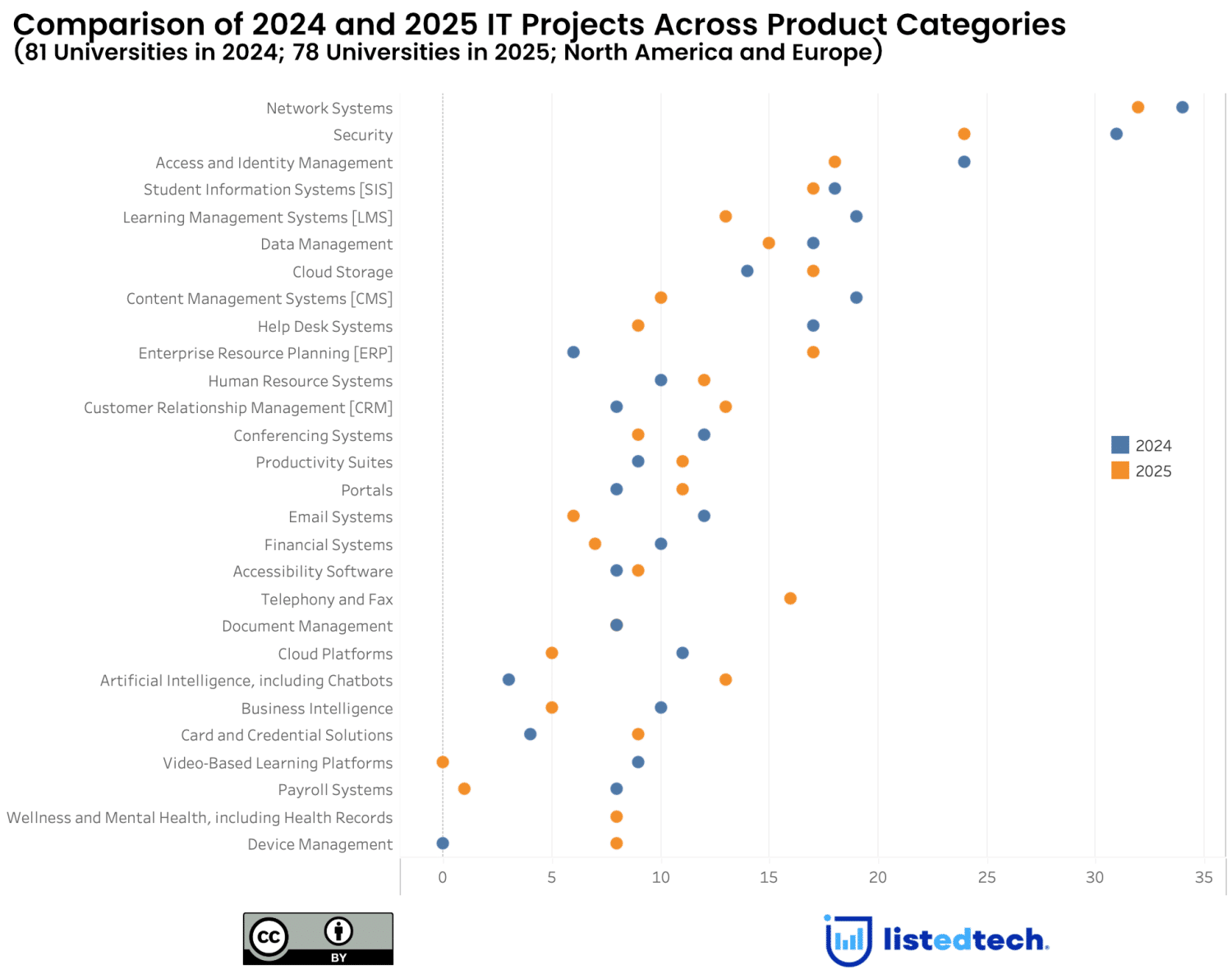
This research examines IT projects currently implemented across 78 higher education institutions in North America and Europe. Drawing from a diverse sample of universities and colleges of varying sizes and governance structures, we analyze centralized IT project data publicly available on institutional websites. This approach allows us to identify overarching themes and trends, such as the prioritization of cybersecurity frameworks, the transition to cloud-based systems, and the integration of artificial intelligence or advanced data analytics tools. By focusing on the collective scope of these initiatives, this study underscores their strategic value in addressing campus-wide challenges.
Methodology
Unlike other media outlets that summarize discussions among a few CIOs and experts about predicted technological trends for the coming year, we take a data-driven approach. We compiled a list of IT projects currently underway at dozens of institutions. This year, we analyzed IT project information published on the websites of 78 universities and colleges across North America and Europe. These institutions span a range of enrollment sizes, and while most are public, our sample also includes 13 private institutions.
To create our Top 10 list, we reviewed the content of 78 IT project webpages from North America and Europe. We focused exclusively on centralized IT project pages, including:
- Northeastern University ITS Ongoing and Future Projects
- University of Colorado IT Governance Projects
We did not include project-specific pages, such as:
Last year, solution representatives also asked why certain products were excluded while their competitors are included. This is simply due to how universities choose to present their projects. Our analysis is always unbiased and based solely on the data available.
The IT projects we identified are grouped into key themes. To qualify for this post, a theme must appear on at least 10% of the institution websites (eight universities). If a single institution lists multiple projects under a theme, we separate them using “//”.
List of IT Projects by Key Themes
Click on the down arrow sign to see the list of institutional project names.
Network Systems (32 universities)
- 5G and Wireless Service // Fiber Project
- Campus Data Network Authentication Deployment
- Campus Network Refresh
- Campus Network UpgradeCampus Network Upgrade
- Campus-wide WiFi
- Eduroam: External Wifi Access & Hubspot on Campus
- Enhance network management
- Expand Shared Directory and Endpoint Service Footprint
- Fiber Backbone Upgrades
- Implement Additional Network Ports // Upgrade RogueDetect
- Improving Wireless
- Network Access Control (NAC)
- Network core refresh
- Network Modernization
- Network Programme
- Network Services & Infrastructure Improvement
- Network Switches Upgrade
- Network transformation
- Network Upgrade (3x)
- New and stronger VPN solution for remote access to the network
- New Internet Platform
- Next Generation Network (3x)
- Upgrading the data network infrastructure and media technology for classroom and hybrid teaching
- WiFi 6 Network Coverage Expansion
- Wireless and wired upgrade
- Wireless Network Expansion
- Wireless Telecom
Security (24 universities)
- Building Security Access
- Cohesity Enterprise Backup and Recovery Replacing NetBackup // Zero Trust Network Access
- CrowdStrike Identity Threat Protection // Cybersecurity Improvement Initiative // Migration to Red Hat Enterprise Linux (RHEL)
- Cybersecurity
- Cybersecurity Maturity Model Certification (CMMC)
- Deploy a unified cybersecurity toolset
- Device Health
- Disaster Recovery Plan // Incident Response Plan // Information Security Awareness Program
- Email Security & Simplification
- Email Security Improvements
- Enhanced email threat defense
- Hazard identification and risk assessment // Institutional cybersecurity awareness platform
- Implementation of M365 Advanced Threat Protection // Implementation of Microsoft SQL Server Clustering
- Improve Campus Safety Technologies // Information Security Investment Plan
- Information Security Investment Plan (ISIP) Project
- New Email Security Features and Processes
- OnPrem Hosting Refresh
- Privileged Access Management
- Security Agent Standardization
- Security Awareness Training // Next Generation Access Control
- Security Program Revision
- State of Information Security Report Completed // Jamf Encryption Migration // Upgrade of FileMaker Server and FileMaker Pro
- Upgrade Oracle Enterprise Linux 7 Servers // Windows 11 Upgrade
- Windows 10 to Windows 11 Migration
Access and Identity Management (18 universities)
- Accounts // Authorization Management
- Active Directory Migrations Project // Profile Project
- Authentication for Online College Directory // SSO with WB Mason
- Duo
- Guest Authentication Project
- Identity and Access Management
- Identity Improvement Programme
- Identity Management and SSO Deployment
- Implement Fischer Identity
- Implement new Identity Management technology
- Improve identity and access management (IAM) processes and capabilities // Mobile ID
- Improve User Experience and Access
- Keeper update
- Multi-factor Authentication (MFA) Implementation
- Multi-factor Authentication for Office 365
- Multifactor authentication for critical business applications
- One Digital Identity Project (Okta)
- Service Account Migration
Cloud Storage (17 universities)
- Assess Storage Solutions // Implement Microsoft Email and Storage Changes
- BackBlaze Implementation
- Box Migration
- Digital Storage Cost Reduction
- Drive Migration to OneDrive and SharePoint
- Google Drive for cloud-based storage
- Google Storage
- Google Storage Limits
- Google Storage Migrations
- Google Storage Project
- Microsoft Storage Changes
- Migration to a new and improved video storage solution for hybrid and online courses
- Research Cloud
- Research Data Condo // DAS Expansion
- Research File Service (RFS)
- Transition of document from legacy file server environment into the cloud leveraging technology from Microsoft Teams
- Zoom Cloud Recordings in Kaltura
Enterprise Resource Planning [ERP] (17 universities)
- New ERP System // Transition PeopleSoft to the Cloud
- Banner Revitalization/Upgrades (3x)
- Convert – Api & SS Code Over to Ellucian API 2.0 and SS 3.0
- Enterprise Software Dev
- ERP Ancillary Systems Program
- ERP Assessment
- Fusion (Transition to cloud) & FusionPlay (module change)
- HR and Finance legacy applications decommissioning
- Implementation of the new LACOE HR/Payroll and Financial System
- Optimize the Workday Experience
- Transition the university to a cloud-based solution for HR/HCM, Finance
- Upgrade Oracle Fusion
- Workday Implementation (3x)
Student Information Systems [SIS] (17 universities)
- Banner Implementation
- Banner Revitalization/Upgrades Initiative (3x)
- HISinOne Standardization in Portal
- Implement – Gradebook connection to Colleague
- Program change resquest platform enhancements
- SIS Implementation (2x)
- SIS Evaluation
- SIS Projects
- SIS Upgrades
- Student Systems GDPR compliance
- Transition PeopleSoft to the Cloud
- Transition the university to a cloud-based solution for SIS
- Workday Student Implementation
Telephony and Fax (16 universities)
- Blue Call Boxes: Upgrading Phone Lines // Upgrading to Ping: The Next Generation of Soft Phone
- Burst telephone capacity for clearing and online open day service
- External Calling Teams Voice
- Fax Server Migration
- Microsoft Teams Telephony project (3x)
- Softphone Pilot
- Teams Voice Pilot
- Telephone Modernization Project
- Telephone Replacement System (2x)
- Telephony 2.0 Project
- VoIP Phone Service Upgrade
- Webex Cloud Calling (Cisco) Implementation
- Zoom Phone Migration
Data Management (15 universities)
- Data Center Network Access Control
- Data Governance and Management
- Data Inventory
- Data Transformation – Enterprise CRM Project
- Data Warehouse
- EDI Data
- Expand the Data Governance Program
- GitHub Campus Program
- Implementation of Data Center Infrastructure Management software
- Information Security (secure data handling)
- Install Palo Alto Networks Firewalls in front of our IS&T data centers
- Management of EDI data
- Revolutionize the Enterprise Data Ecosystem
- Server Reduction and Data Center Modernization
- Simplifying Banner Data Storage
Learning Management Systems [LMS] (13 universities)
- Canvas Accessibility
- Canvas Enhancements // Exam Paper Archive
- Canvas Implementation Project (2x)
- Canvas Pilot Project
- Learning management system
- Learning Management System (LMS) Upgrade Project // Learning Management System for HR
- Learning Management System Review
- LMS Transition to Canvas
- Moodle Enrollment Integration
- Moodle Upgrade (2x)
- Move to Blackboard Learn Ultra // Oracle Learning
Artificial Intelligence, including Chatbots (13 universities)
- Academic Applications of AI
- AI Chatbot
- AI Chatbots for Open-Access Teaching (Pilot) // University GPT (Pilot) // AI Website Launch
- AI Community of Interest
- AI Fluency // AI Inventory Report
- AI@Univ Initiative
- Artificial Intelligence
- Bing Chat Enterprise// Ask Wilson
- Copilot Early Adopters
- Evaluate Chatbot AI for Internal and External Use
- Generative Artificial Intelligence
- Leverage Artificial Intelligence
- Private Generative AI Pilot
Human Resource Systems (12 universities)
- BDM Project for Human Resources and Payroll
- Common Human Resources System (CHRS)
- Employee Applicant Tracking System Replacement
- Equifax’s The Work Number Project for Employment and Income Verification
- HR System Assessment
- Implement – Benefits Administration Platform Solution // PageUp Implementation
- Performance Management – Phase Two (Reporting) // Implementation of monthly leave/approval conversion
- NeoEd Implementation
- New HR and Payroll system
- Workday HCM Implementation
- TA Pool (Faculty)
- TIAA Lead Administrator for Retirement Funds
- Time and Labor
Productivity Suites (11 universities)
- G Suite for Education
- Google Workspace for Education Service Redesign
- Office 365 Implementation (7x)
- Reshaping the Google Workspace Service
- Simplify M365 for Collaboration
Portals (11 universities)
- Campus Portal Redesign
- Deploy Self-Service
- Ellucian Colleague Self-Service
- Enhanced Student Center with HighPoint software
- my.University Portal
- MyUniversity Portal Modernization
- New UniversityLink Experience
- New Community Platform
- Octopus Portal
- Self-Service Banner
- SharePoint Online migration
- Student Portal & Academic Transactions
Content Management Systems [CMS] (10 universities)
- Drupal 10 Upgrade
- Empower University Online // Transform the Web Experience
- Interactive Map
- IT Division Website Updates
- Kubernetes and Further Improvements to Our Web Project Deployments
- New Website
- OnBase Replacement
- WebCMS Project
- Website Improvement Program
- Website Updates
Accessibility Software (9 universities)
- Accessibility
- Accessibility Scanning
- Accessibility Website
- Closed Captioning
- Digital Accessibility and Universal Design Workshops in Partnership with Disabilities Services // Assess – Current technology systems and tools to ensure accessibility
- Digital Accessibility
- Digital Accessibility Assessment and Strategic Plan
- Mature Digital Accessibility
- Public Website Accessibility Remediation // AAS Case Management
Card and Credential Solutions (9 universities)
- Digital Credentialling for the LMS (Canvas)
- Facilities key management // Migration to OneCard
- IGA Modernization
- Integrated OneCard ID and Access System
- Smart Access
- Student Digital Credentials
- TouchNet OneCard
- Security Keys
- OneCard to Cloud
Conferencing Systems (9 universities)
- Enterprise Video Platform (2)
- Kaltura Video Implementation (2x)
- Kaltura Contract Renewal // Explore – OtterAI Add-on for Zoom
- Microsoft Teams replacing Zoom
- Skype for Business Upgrade
- Slate for Co-Curricular Opportunities
- Snell Library Renovation and Teams Implementation
- Web Chat for TSC
Help Desk Systems (9 universities)
- Automated Call Distribution (ACD) Project
- Enhance Service Management
- IT Service Management
- IT Experience Transformation
- New Technical Support Website
- ServiceLink Transformation
- TeamDynamix Implementation (3x, replacing Footprints, ServiceNow, and WebQA)
Document Management (8 universities)
- Banner Document Retention Scripting
- Digital Forms Routing and Approval
- Digitisation of various forms
- Digitizing the Employee File Pilot
- DocuWare Application and Server Upgrade
- eFile
- File Storage Standard Enactment Implementation
- Forms and Process Digitization
- Online University document request process
Wellness and Mental Health, including Health Records (8 universities)
- Campus Response and Support – Case Management System
- Implement Medicat’s hosted (cloud) solution
- Medical Record System Implementation
- Medproctor Implementation (Magnus Replacement) // Fitness Release Time (FRT) Workflow
- Mental Well-Being for Students
- New student case management system
- Student Peer-to-Peer Mentoring System
- Support the University Health Digital Transformation strategy // Move University Health EHR Disaster Recovery to the Cloud
Device Management (8 universities)
- Endpoint Management – Implementation
- Enhanced Endpoint Management – Prohibited Technologies Inclusion
- Enrollment of Windows-based end-user devices in an automated management tool
- ETS Server Virtualization/VM Project
- Microsoft Intune Implementation (3x)
- Windows Unified Device Management
IT Priorities Groupings and Explanations
1. Network and Security: Network Systems (32), Security (24), Device Management (8)
With identity theft and cyber-attacks on the rise, universities, like other businesses with a large technological footprint, must prevent these attacks. Network upgrades, software updates, and investments in security infrastructure are necessary to attain this goal.
2. Core Systems: Student Information Systems (17), Enterprise Resource Planning (17), Human Resource Systems (12)
Student records, employee records, and invoicing, are vital IT systems needed to ensure smooth operations in higher education. With an average age of ten years for most of these systems, it is normal that 25-40% of universities are in the process of replacing or updating these systems each year.
3. Data and Storage: Cloud Storage (17), Data Management (15), Document Management (8)
Universities are investing in cloud platforms and cloud storage to ensure that students and employees alike can work more efficiently in a more secure environment. Cloud storage projects are also linked to data management strategies to organize, secure, and utilize data assets. It aligns data practices with business goals, enhances data quality and security, and supports the organization’s ability to leverage data for innovation and competitive advantage.
4. Identity Management: Access and Identity Management (18), Portals (11), Card and Credential Solutions (9)
This grouping includes identity management and multi-factor authentication. Combined with network systems and security projects, single-sign-on projects ensure that the security of IT infrastructure is at its peak and that academic data is secure.
5. Communication: Telephony and Fax (16), Content Management Systems (10)
Following the pandemic and the restructuring of some services offered on campus, institutions have reduced the need to have physical landlines and many prefer to use Teams (or similar systems) as their main communication device.
6. Learning Perspectives: Learning Management Systems (13), Conferencing Systems (9)
One of the key missions of any university is to provide the best learning experience to its students. Investing in learning management systems and online video infrastructures is necessary, especially since the pandemic hit.
7. Student Support Systems: Accessibility Software (9), Wellness and Mental Health (8)
Student well-being and accessibility solutions encompass tools that focus on fostering inclusivity, equity, and holistic support for all students. Accessibility software ensures that students with disabilities can fully engage with academic resources, while wellness and mental health platforms provide crucial support for managing stress, maintaining mental well-being, and promoting a healthy campus environment.
8. Artificial Intelligence (13)
Universities use artificial intelligence to enhance efficiency, improve the student experience, and stay competitive in a rapidly evolving educational landscape. AI streamlines administrative processes, personalizes learning experiences, and provides round-the-clock support through virtual assistants. It also helps identify at-risk students, analyze institutional data for strategic decision-making, and drive innovation in research. By leveraging AI, universities can create more inclusive, adaptive, and effective environments that meet the diverse needs of students and staff.
9. Productivity Suites (11)
These days, it’s unthinkable to go a day without opening our e-mail or using one of our productivity tools, such as word processing, spreadsheets or presentation software. Even though these projects may seem less critical than those related to security, for example, they remain essential to an effective technological environment.
10. Help Desk Systems (9)
As universities move into more complex technology environments, offering more computerized solutions, IT departments need to invest in accompanying solutions for technical support. In our sample, projects are very diverse, although implementation of new help desk systems are more numerous.
How Does This Study Compare to the 2025 EDUCAUSE Top 10?
Although in previous years, the Educause Top 10 article title included “IT” in it, they always included business priorities that are not necessarily linked to IT departments. This year is no exception.
Furthermore, we have seen that priorities put forward by institutions sometimes matched their project roadmap.
Here is a side-by-side table of the Educause Top 10 and ours:
| Educause | ListEdTech | Notes |
|---|---|---|
| 1. The Data-Empowered Institution | 3. Data and Storage | Our findings on cloud platforms, data management, and AI align with EDUCAUSE’s emphasis on leveraging data innovation, efficiency, and enhanced student success. |
| 2. Administrative Simplification | 2. Core Systems | Upgrading and replacing core systems directly supports administrative simplification, mirroring EDUCAUSE’s focus on modernizing processes and technology. |
| 3. Smoothing the Student Journey | 6. Learning Perspectives | Enhancing learning management and conferencing systems contributes to improving the student journey, aligning with EDUCAUSE’s goal of personalizing services for students. |
| 4. A Matter of Trust | 1. Network and Security | Investments in security infrastructure, network upgrades, and device management align with EDUCAUSE’s priority of safeguarding privacy and securing institutional data. |
| 5. The CIO Challenge | Our analysis does not focus on business challenges, restructuring or policy changes. Therefore, this EDUCAUSE priority does not have an equivalency in IT projects. | |
| 6. Institutional Resilience | Same as above | |
| 7. Faster, Better, AND Cheaper | 8. Artificial Intelligence and 10. Help Desk Systems | Artificial Intelligence supports institutional automated processes and upcoming personalized experiences to both students and employees. In addition, help desk systems streamline technical support allowing for a faster problem resolution. |
| 8. Putting People First | 7. Student Support Systems | Supporting student well-being, accessibility, and help desk systems demonstrates a shared focus on prioritizing the needs of people, as EDUCAUSE advocates. |
| 9. Taming the Digital Jungle | 4. Identity Management | Our findings align with EDUCAUSE’s priority of unifying digital infrastructure for greater efficiency and effectiveness. |
| 10. Building Bridges, Not Walls AND Supportable, Sustainable, and Affordable | 5. Communication AND 9. Productivity Suites | It is essential to provide university communities with the tools they need to communicate effectively with one another and with university structures. |
What Can We Learn From This Research?
The IT priorities identified in this research highlight the strategic importance of technology in addressing the evolving challenges faced by higher education institutions in 2025. From enhancing security and modernizing core systems to leveraging artificial intelligence and fostering inclusivity, these projects reflect a collective effort to build resilient, efficient, and student-focused campuses.
By analyzing data from 78 institutions across North America and Europe, we provide a comprehensive overview of the IT themes shaping higher education. These findings not only complement broader industry trends, such as those identified by EDUCAUSE, but also underscore the critical role of data-driven insights in guiding decision-making.
As institutions continue to navigate a complex technological landscape, the success of their IT strategies will depend on their ability to prioritize sustainability, innovation, and the holistic needs of their communities.