
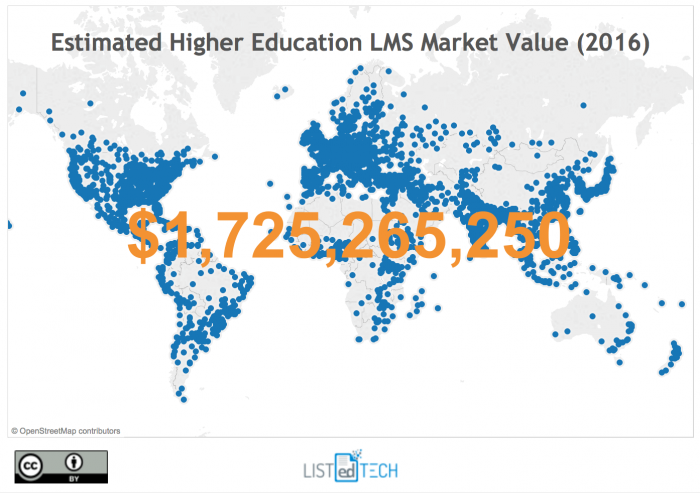
After reading an article entitled “Billion-dollar e-learning market about to undergo major shift“, I started wondering if that number, the “billion dollar”, was actually a good evaluation. Several questions came to mind:
Is this just the US value or world value?
When they use ‘e-learning’, does that include LMS, MOOCs and peripheral systems?
How does open source impact this evaluation?
Am I asking too many questions?
Since this is a big and difficult question to answer, consider this my attempt to contribute to that discussion with the data I have at my disposal. My hope is that this post opens a discussion on the frequently stated “one-billion dollar” valuation. I will only be looking at the higherEd data to get a sense on the scope of the market, since consolidated K-12 data is much harder to come by.
Since major vendors charge by the number of students in a given institution, I will use the following formula:
(# of students) * (average cost of LMS per student) = annual spending
Canada and USA LMS Market
I looked at a mix of 16 contracts signed in the last 4 years by major LMS players (Blackboard, Instructure, D2L and Angel) and averaged out the annual price per student to be about $18. Given this information, prices did fluctuate based on things like: hosted vs self hosted, number of years for the contract, premium support models (20% of the subscription rate or about $3 per user), total size of the institutions or consortium (500 vs 600,000 students), number of bells or the colour of your whistle. There are too many factors to break it down into exact numbers, but since I had a fairly good representation I will stick to $18 per student.
For the amount of open source systems (i.e. Moodle and Sakai), whether as self-hosted or hosted, I will simply use a $5 flat rate per student as a hosting fee. I won’t look at the development cost since it is not evenly distributed. Bigger institutions or companies often drive development for different reasons.
In our wiki, we have 5,500 active LMS for Canada and the USA. Remember, some institutions use more than one system. Assuming that we are missing 10% of the institutions, we can round it up to 6,000 LMS systems. Using the student population of each college or university, this represents:
Proprietary system: 24,200,000 (students) x $18 (Avg. LMS cost per student) = $435,600,000
Open source: 6,160,000(students) x $5 (Avg. hosting cost per student) = $30,800,000
Add 1 time fees for initial implementations:
$10,000 training cost
Implementation/Migration fees ($5-10 per course). Let’s say $11,000.
Based on our data, the average number of new implementations per year over the last 5 years is around 525 (or 10%). Therefore, 525 (new implementations) x $21,000 (training +Implementation fee) = $11,025,000.
Based on our data, we would estimate that the Canada and US HigherEd yearly market is worth about $477,425,000.
International HigherEd Market
We know that for international institutions, the LMS usage is somewhat lower. So let’s assume 50% for our purposes (so, 50% of 17,170 international institutions would be using 1 LMS).
We also know that open source (Claroline, Ilias, Sakai and primary Moodle) is bigger in the international market. Based on the data in the wiki, we estimate that about 65% use open source systems.
On the international scale, the average size of enrolment is 15,000 per institution.
17,170 institutions x 50% = 8,585 institutions using a LMS
8,585 institutions x 15,000 students = 128,775,000 students
If we split that up into open source and proprietary using the same monetary numbers as we did for Canada and the USA (even if they probably pay a lower amount).
Proprietary system (35%): 45,071,250 (students) x $18 (Avg. LMS cost per student) = $811,282,500
Open source (65%): 83,703,750 (students) x $5 (Avg. hosting cost per student) = $418,518,750
As in the previous section hypothesis, about 10% of institutions with an LMS have a new implementation per year. Therefore, in the case of international institutions, the number comes out to 859 institutions x $21,000 = $18,039,000.
World higher education yearly LMS market (including Canada and the USA) is about $1,725,265,250.
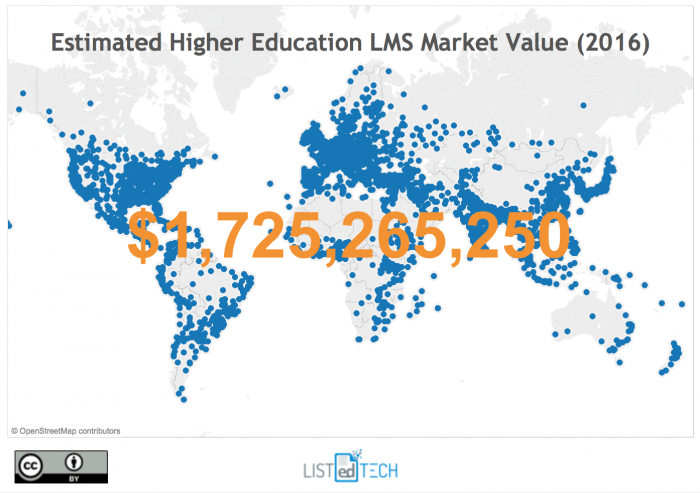
Just to clarify what the 1.7 billion represents:
the world value;
it only takes into account the Learning Management Systems and not MOOCs or peripheral systems;
it only includes higher education and NOT k-12 and business markets;
it only takes into consideration open source hosted/self-hosted costs but not the price of internal or hired software development.
In conclusion, it looks as if the “billion-dollar market” is not only realistic, it is probably too low. Billion-dollar might be accurate for US & Canada alone if you add in K-12 numbers…